
What is FM-200 fire extinguishing agent?
The chemical name of FM-200 is heptafluoropropane, with the molecular formula CF ∝ CHFCF ∝. It is a colorless, odorless, non-conductive clean gas.
Its core advantages include:
Efficient and fast: The fire extinguishing time is usually within 10 seconds.
Clean and residue free: After extinguishing the fire, there is no residue left and it will not cause damage to sensitive electronic devices.
Safe and reliable: It has no toxic side effects on the human body and can be used in places where personnel work.
Environmentally friendly: No destructive effect on the atmospheric ozone layer (ODP value of 0).
How does the system work?
The working principle of FM-200 cabinet fire extinguishing system combines physical and chemical fire extinguishing methods:
Physical cooling: The agent rapidly vaporizes during spraying, absorbing a large amount of heat to cool the flame.
Chemical inhibition: The agent releases free radicals in the flame, interrupting the chain reaction of combustion and thus terminating the combustion.
A complete system typically consists of the following parts:
Detection section: including temperature and smoke detectors, used for real-time monitoring of the protected area.
Control part: including fire alarm controller, sound and light alarm, etc., used to receive signals and issue instructions.
Execution part: including steel cylinders, container valves, solenoid valves, high-pressure hoses, nozzles, etc. for storing fire extinguishing agents.
Workflow:
Detection: When a fire occurs in the protected area, the detector emits a fire alarm signal.
Alarm and linkage: After logical analysis, the controller will first issue an audible and visual alarm and issue linkage instructions (such as closing air conditioning, fire dampers, etc.).
Delay and release: After a set delay time, the controller issues a fire extinguishing command and opens the container valve to release the fire extinguishing agent.
Manual start: When the on duty personnel discover a fire, they can also press the emergency start button outside the protected area or use the mechanical emergency start device on the steel cylinder to manually release the fire extinguishing agent.
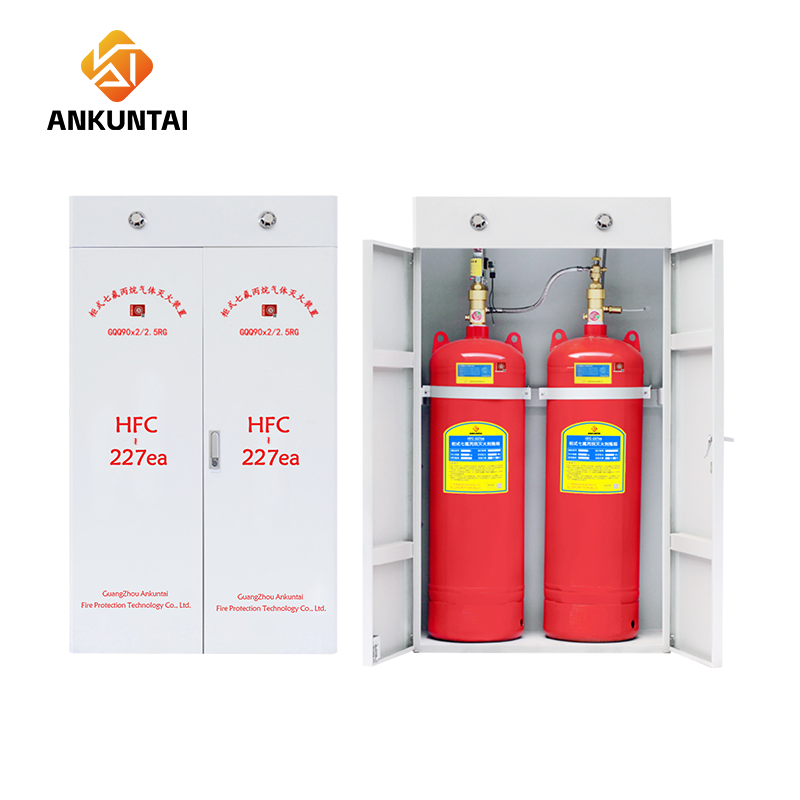
Characteristics of Cabinet System
The FM-200 cabinet fire extinguishing system is usually prefabricated:
Integrated design: Integrating core components such as gas storage cylinders, control valves, nozzles, etc. into a metal cabinet.
Pipeline free design: The system itself usually does not require the installation of complex pipelines and can be directly placed inside or next to the protective cabinet.
Compact appearance: The cabinet design is aesthetically pleasing, with a compact structure that saves space.
Main application scenarios
This system is widely used to protect critical facilities and high-value equipment:
Data center and server room: protect data security and equipment operation.
Communication base stations and telecommunications facilities.
Precision instruments and medical equipment.
Electricity and distribution facilities.
Industrial equipment such as CNC machine tools.
Difference from pipeline system
Characteristics: Cabinet Type System, Pipe Network Type System
Pipelines do not require complex pipe networks and are easy to install, requiring the installation of specialized pipelines
Small space occupation, can be directly placed in a separate gas cylinder room in the protected area
Applicable scenarios include single or few cabinets, large computer rooms with limited space, and multiple protective zones
Scalability is relatively fixed, and expansion requires the addition of new cabinets that can be flexibly expanded to multiple areas through pipeline design
Overall, the FM-200 cabinet fire suppression system is an efficient, clean, and safe active fire-fighting facility, and a reliable choice for protecting modern information technology and critical electronic equipment from fire threats.