
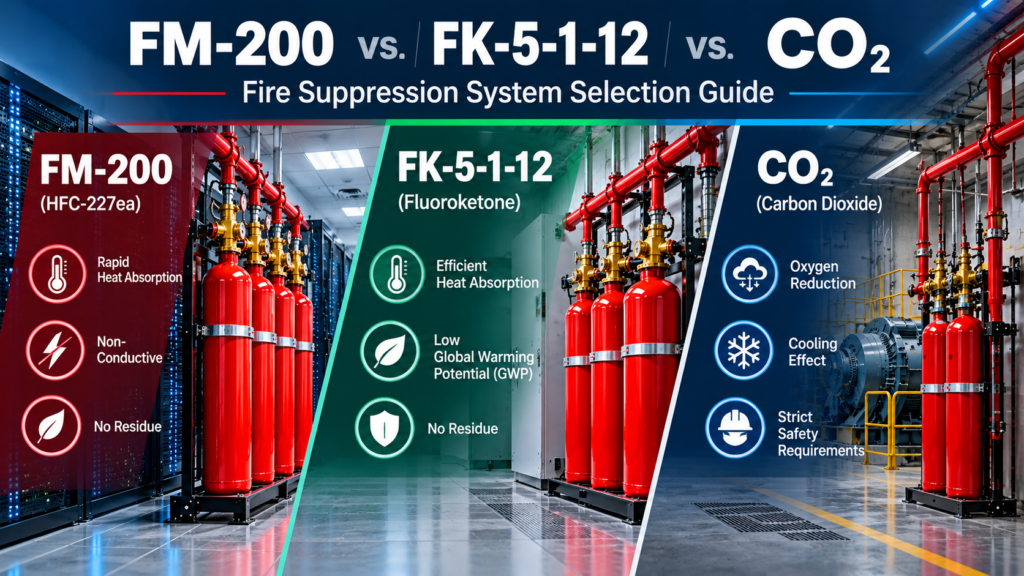
Selecting a gaseous fire suppression system is not simply a matter of choosing the most familiar extinguishing agent or comparing cylinder prices.
For data centers, electrical rooms, industrial machinery spaces, and other critical facilities, the choice between FM-200, FK-5-1-12, and CO₂ can affect personnel safety, equipment protection, environmental compliance, installation requirements, and long-term maintenance.
All three agents can be used in engineered fire suppression applications, but they have different characteristics, safety requirements, and application limitations.
This guide compares their working principles, technical characteristics, applications, and engineering considerations to help EPC contractors, fire protection engineers, and international project buyers make informed decisions.
For a general introduction to clean-agent protection, read our Complete Guide to FM-200 Fire Suppression Systems.
1. Understanding the Three Fire Suppression Agents
What Is FM-200 (HFC-227ea)?
FM-200 is a commonly used trade name for fire suppression systems employing HFC-227ea, a halocarbon clean extinguishing agent.
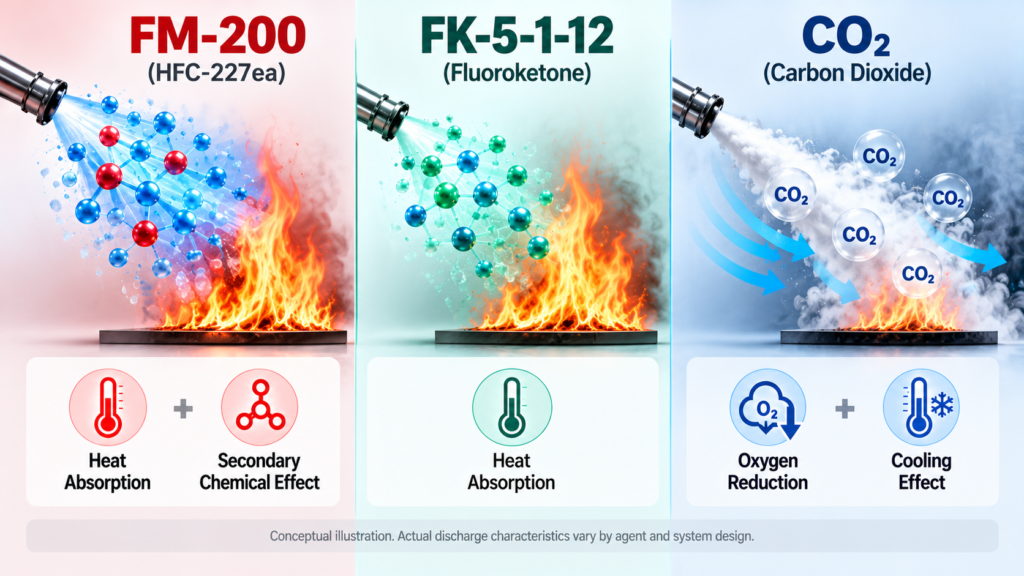
It suppresses fire primarily through heat absorption, with a secondary chemical contribution to extinguishment.
FM-200 is electrically non-conductive and does not leave solid extinguishing residue after discharge.
These characteristics make engineered FM-200 systems an option for protecting certain electrical and electronic equipment environments.
Typical applications include:
- Data centers and server rooms.
- Electrical and control rooms.
- Telecommunications facilities.
- Selected industrial equipment enclosures.
- Facilities requiring clean-agent protection.
However, HFC-227ea has a relatively high global warming potential. Its use must be evaluated against applicable environmental regulations and project requirements.
For more details about its operating sequence, see our How Does an FM-200 Fire Suppression System Work? guide.
What Is FK-5-1-12?
FK-5-1-12 is a fluoroketone clean extinguishing agent used in engineered gaseous fire suppression systems.
Like FM-200, it is electrically non-conductive and does not leave solid residue after discharge.
It suppresses fire mainly by absorbing heat from the combustion process.
One of its important characteristics is its substantially lower global warming potential compared with HFC-227ea.
Typical applications may include:
- Data centers and IT facilities.
- Electrical equipment rooms.
- Telecommunications installations.
- Control rooms.
- Selected commercial and industrial enclosures.
FK-5-1-12 is the chemical designation of the extinguishing agent, while Novec 1230 was a branded product name associated with 3M.
3M completed its exit from PFAS manufacturing at the end of 2025. This does not automatically mean that all FK-5-1-12 products from other manufacturers are unavailable.
Project buyers should distinguish between the chemical agent, its manufacturer, and the approvals or certifications applicable to the complete extinguishing system.
Equivalent chemical designation alone does not guarantee equipment interchangeability.
What Is CO₂ Fire Suppression?
Carbon dioxide is a gaseous extinguishing agent used in fixed fire suppression systems, including total flooding and local application arrangements.
Carbon dioxide suppresses fire primarily by reducing the oxygen concentration available to sustain combustion, while cooling also contributes to its extinguishing action in certain applications.
CO₂ is electrically non-conductive and leaves no solid extinguishing residue.
However, carbon dioxide systems can create life-threatening atmospheric conditions at extinguishing concentrations.
This makes personnel exposure a critical consideration during system selection and design.
CO₂ systems are often evaluated for industrial hazards such as:
- Machinery enclosures.
- Selected turbine and generator installations.
- Certain industrial process equipment.
- Selected manufacturing facilities.
- Other applications where CO₂ protection is permitted and appropriate.
For total flooding applications, spaces where personnel may be present require careful evaluation of applicable restrictions, evacuation procedures, warning devices, lockout arrangements, and emergency safeguards.
CO₂ must not be selected simply because the initial equipment price appears economical.
2. FM-200 vs. FK-5-1-12 vs. CO₂: Technical Comparison
The following table summarizes the main differences between these three fire suppression agents.
| Comparison | FM-200 | FK-5-1-12 | CO₂ |
|---|---|---|---|
| Agent | HFC-227ea | Fluoroketone | Carbon dioxide |
| Fire suppression | Primarily heat absorption | Primarily heat absorption | Oxygen reduction and cooling |
| Electrical conductivity | Non-conductive | Non-conductive | Non-conductive |
| Solid residue | None | None | None |
| Personnel safety | Exposure limits apply | Exposure limits apply | Serious asphyxiation hazard |
| Climate impact | High GWP | Very low GWP | GWP reference value: 1 |
| Typical applications | Sensitive equipment | Sensitive equipment | Selected industrial hazards |
| Main standard | NFPA 2001 | NFPA 2001 | NFPA 12 |
Important: This comparison is intended for preliminary selection only.
Actual design concentrations, agent quantities, discharge arrangements, personnel exposure limitations, and required safety measures must be determined for the specific project.
The three extinguishing agents should not be treated as directly interchangeable.
3. Which Fire Suppression System Is Better for Data Centers?
Data centers require careful fire protection planning because both equipment damage and operational interruption can have significant consequences.
Sensitive electronic equipment may be vulnerable to water damage, while unplanned downtime can interrupt servers, communication networks, and business operations.
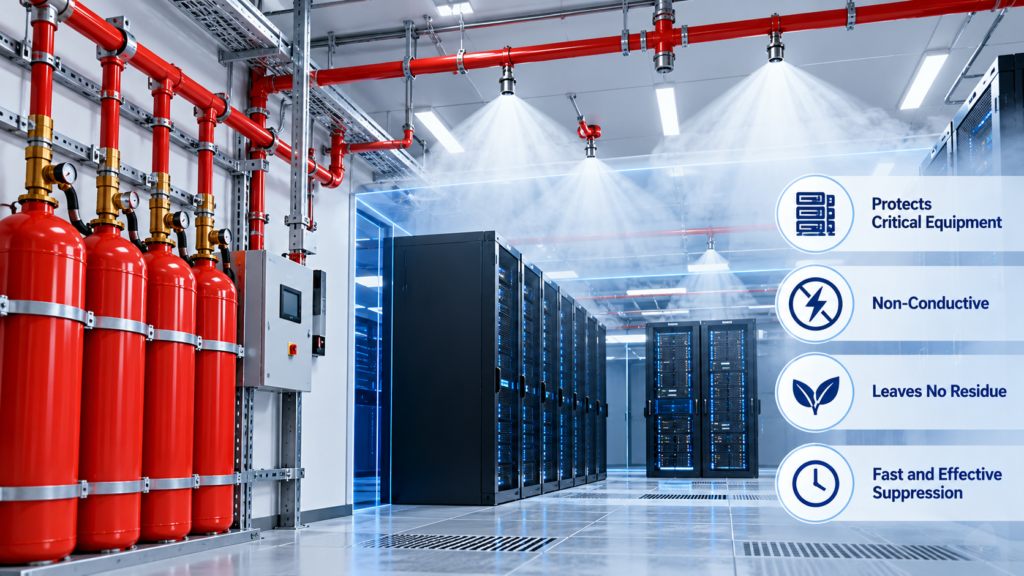
FM-200 and FK-5-1-12 are both candidates for engineered clean-agent protection in suitable data center environments.
Their electrically non-conductive characteristics and absence of solid extinguishing residue can help reduce secondary damage associated with the suppression agent.
However, neither agent should be selected solely because it is described as a clean agent.
Engineering teams must evaluate:
- The fire hazards inside the protected space.
- Occupancy and personnel exposure requirements.
- Room dimensions and enclosure integrity.
- Ventilation and airflow conditions.
- Required extinguishing concentrations.
- Applicable building and fire codes.
- Agent availability and maintenance requirements.
- Equipment compatibility and applicable approvals.
For new projects emphasizing lower direct global warming impact, FK-5-1-12 may offer an environmental advantage over HFC-227ea, subject to applicable chemical and fire protection regulations.
FM-200 may remain an option where its use is permitted and the selected system meets the project requirements.
CO₂ total flooding systems present serious life-safety hazards and should not be treated as interchangeable with clean-agent systems intended for suitable occupied environments.
The final selection must be supported by a qualified fire protection design.
4. Which Agent Is More Suitable for Industrial Machinery?
Industrial machinery protection often involves different hazards from those found in commercial data centers.
Machinery spaces may contain combustible lubricants, electrical components, hot surfaces, or industrial processes with particular ignition risks.
Some protected areas are normally unoccupied, while others require regular access for inspection and maintenance.
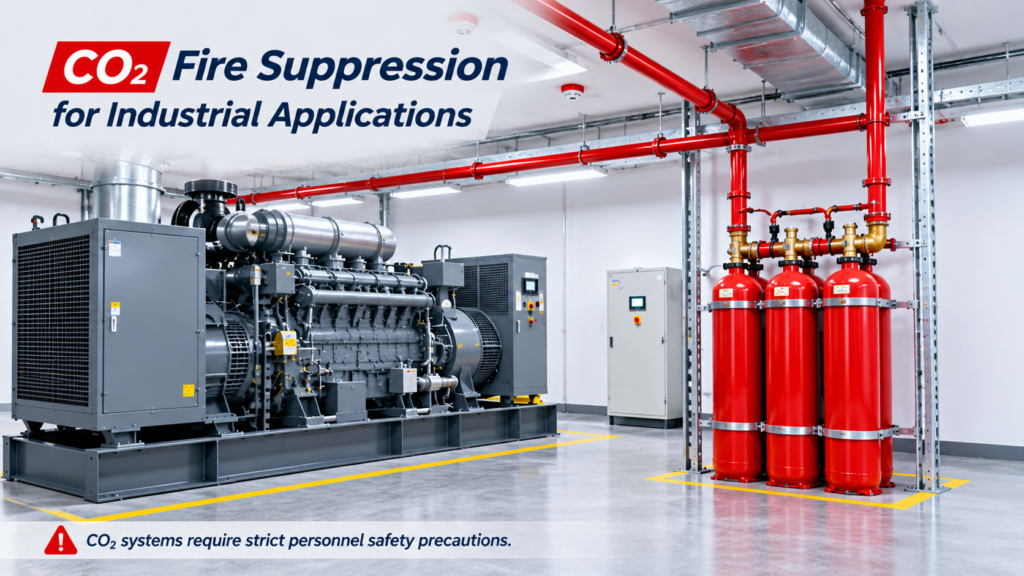
CO₂ may be considered for appropriate industrial applications when the identified hazards and governing standards support its use.
However, personnel access and maintenance activities can significantly influence whether a CO₂ system is suitable.
FM-200 and FK-5-1-12 may also be evaluated for selected industrial equipment enclosures.
Their suitability depends on the nature of the hazard, enclosure conditions, applicable agent limitations, and the engineered system configuration.
Certain reactive metals, chemical reactions, or special fire hazards may fall outside the permitted applications of particular gaseous agents.
The correct approach is to identify the hazard first and select the suppression technology second.
5. Personnel Safety: The Most Important Difference
One of the biggest mistakes in gaseous fire suppression selection is assuming that every gas-based system is equally suitable for occupied spaces.
This is not the case.
FM-200 and FK-5-1-12
Both agents are addressed by clean-agent fire suppression standards, including NFPA 2001.
Where permitted, their use in normally occupied areas depends on compliance with applicable exposure limitations, design concentrations, warning arrangements, and other safety requirements.
Neither agent should be described as harmless to personnel under all conditions.
The fire itself, thermal decomposition products, and the circumstances of discharge can create additional hazards.
Carbon Dioxide
CO₂ presents a different and much more severe personnel exposure concern.
At concentrations used for fire extinguishment, carbon dioxide can create an immediately dangerous atmosphere.
Fixed CO₂ installations therefore require rigorous evaluation of:
- Personnel access and occupancy.
- Audible and visual warnings.
- Evacuation arrangements.
- Prevention of inadvertent discharge.
- Maintenance lockout procedures.
- Emergency response requirements.
- Applicable safety regulations.
Where these risks cannot be properly managed, an alternative fire suppression approach should be evaluated.
Personnel safety must be established before comparing equipment prices or installation costs.
6. Environmental Regulations and Long-Term Agent Availability
Environmental regulations and long-term supply considerations are increasingly important in international fire protection projects.
FM-200 and HFC Regulations
HFC-227ea has zero ozone depletion potential but relatively high global warming potential.
Regulations in some markets may affect new installations, agent procurement, servicing, and future availability.
Project buyers should verify the requirements of the destination country or region before approving the system specification.
FK-5-1-12 and Supply-Chain Evaluation
FK-5-1-12 has substantially lower global warming potential than HFC-227ea.
However, low global warming potential does not automatically establish universal regulatory acceptance.
Chemical regulations and supplier qualifications may differ between markets.
Following 3M’s exit from PFAS manufacturing at the end of 2025, buyers should distinguish between historical Novec 1230 branding and FK-5-1-12 supplied by other manufacturers.
Important checks include:
- Agent identity and chemical specifications.
- Agent purity and quality documentation.
- Compatibility with the selected system.
- Applicable system approvals.
- Local regulatory requirements.
- Future refill availability.
CO₂ and Environmental Considerations
Carbon dioxide has a global warming potential reference value of 1 and is not an ozone-depleting extinguishing agent.
Nevertheless, its environmental characteristics do not eliminate the serious personnel safety requirements associated with fixed CO₂ fire suppression.
Environmental performance and human safety must be evaluated separately.
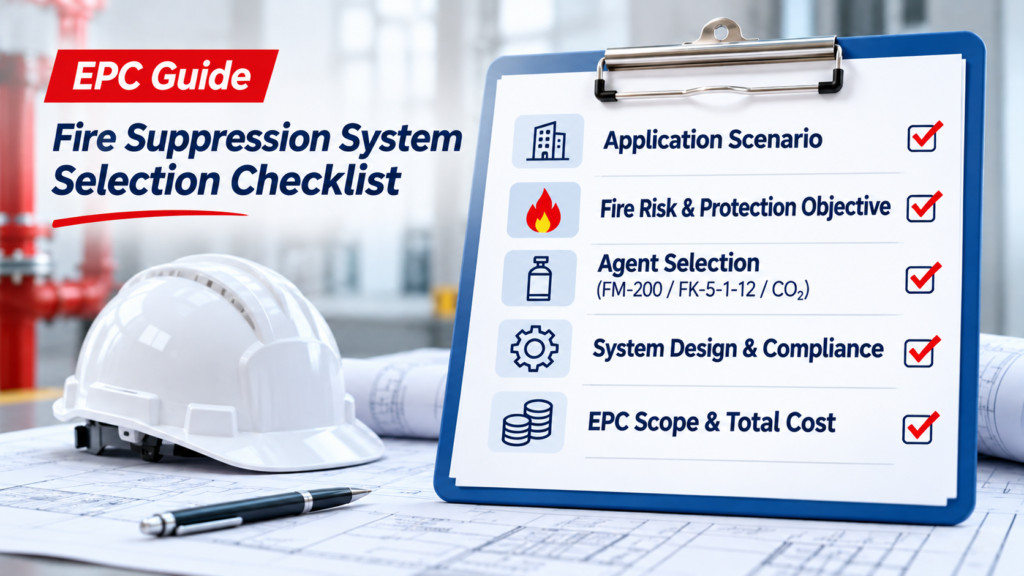
7. How to Select a Fire Suppression System for an EPC Project
Instead of asking which agent is universally best, EPC contractors should follow a structured engineering selection process.
Step 1: Identify the Protected Hazard
Determine what equipment, materials, or processes require protection.
A data center, electrical switchgear room, generator enclosure, and industrial process area may require different solutions.
Step 2: Evaluate Occupancy and Personnel Access
Confirm whether the protected space is normally occupied, occasionally accessed, or normally unoccupied.
Consider maintenance activities, emergency access, and possible unintended personnel exposure.
Step 3: Review Applicable Standards
Identify the governing fire protection codes, building regulations, environmental requirements, and customer specifications.
NFPA 2001 and applicable ISO 14520 provisions are important for relevant clean-agent systems.
NFPA 12 is a key reference for carbon dioxide systems.
ISO 14520-1:2023 does not include CO₂ systems, which are addressed by separate standards.
The applicable standards and editions must be confirmed for the project location.
Step 4: Assess the Protected Enclosure
For total flooding systems, evaluate enclosure volume, leakage paths, ventilation interfaces, and the ability to achieve and maintain the required extinguishing concentration.
Step 5: Verify System Documentation
Request technical documentation for the proposed equipment configuration.
These documents may include:
- Agent specifications.
- Product technical datasheets.
- System design manuals.
- Applicable certification or approval documents.
- Control and releasing logic.
- Installation and maintenance instructions.
A certificate covering an individual component must not be treated as proof of approval for the complete system.
Step 6: Evaluate Maintenance and Future Support
Consider agent replenishment, replacement components, inspection requirements, service personnel, and local maintenance capabilities.
Initial equipment cost represents only one part of the system’s lifecycle requirements.
8. Common Fire Suppression Selection Mistakes
Several recurring mistakes can create problems during engineering review or international procurement.
Mistake 1: Choosing the Lowest Cylinder Price
A lower equipment price does not necessarily result in a lower installed or lifecycle cost.
System components, design requirements, installation, safety functions, and maintenance also affect project cost.
Mistake 2: Ignoring Occupancy Conditions
An agent suitable for one industrial enclosure may be inappropriate for another area where personnel are regularly present.
Mistake 3: Assuming All Clean Agents Are Interchangeable
Different agents may require different storage arrangements, hydraulic calculations, nozzles, valves, and approvals.
Mistake 4: Treating a Component Certificate as System Approval
The certification or listing scope must be checked against the actual equipment being supplied.
Mistake 5: Overlooking Future Agent Availability
Fire suppression installations may remain operational for many years.
Long-term availability of the extinguishing agent and replacement parts should be considered before procurement.
9. Questions to Ask a Fire Suppression Supplier Before Ordering
Before requesting a final quotation, EPC contractors and project buyers should clarify the following:
- Which fire hazards is the proposed system intended to protect?
- Is the protected area normally occupied or regularly accessed?
- Which standards and approval requirements apply?
- What extinguishing agent and system configuration are proposed?
- What engineering calculations and technical documents can be supplied?
- Which components and accessories are included in the quotation?
- How will the suppression system interface with detection, ventilation, and alarms?
- What are the inspection, maintenance, and recharge requirements?
- Are compatible agents and replacement parts available in the destination market?
- Which tests and documents are required for final project acceptance?
These questions help buyers compare technical proposals consistently rather than relying only on quoted equipment prices.
10. Frequently Asked Questions
Is FK-5-1-12 Better Than FM-200?
Neither agent is universally better for every project.
FK-5-1-12 has a substantially lower global warming potential, while the suitability of either system depends on the protected hazard, occupancy conditions, regulations, equipment approvals, and supply requirements.
Can CO₂ Protect Electrical Equipment?
Yes. CO₂ is electrically non-conductive and may be used for certain electrical or industrial equipment hazards.
However, its serious personnel safety risks require careful evaluation of the protected area and applicable standards.
Is FM-200 Safe for Occupied Rooms?
FM-200 may be permitted in certain occupied applications when the engineered system meets applicable exposure and personnel safety requirements.
It should not be assumed safe at every concentration or under every discharge condition.
Is Novec 1230 the Same as FK-5-1-12?
Novec 1230 was a 3M branded extinguishing fluid, while FK-5-1-12 identifies the underlying chemical.
The same chemical designation does not automatically mean that different supplied systems have identical approvals or interchangeable components.
Can an Existing FM-200 System Be Converted to FK-5-1-12?
A direct agent substitution should not be assumed possible.
Containers, valves, nozzles, hydraulic calculations, controls, and system approvals may require reassessment.
Any conversion must follow applicable engineering, manufacturer, and regulatory requirements.
Which System Is the Cheapest?
There is no universal answer.
Total cost depends on protected volume, required agent quantity, equipment configuration, installation conditions, safety requirements, and long-term servicing.
Which Fire Suppression Standards Should I Check?
NFPA 2001 and the applicable ISO 14520 provisions are important references for relevant clean-agent systems.
NFPA 12 and applicable carbon dioxide system standards are important for CO₂ installations.
ISO 14520-1:2023 does not include CO₂.
The governing jurisdiction determines which standards and editions must be followed.
Conclusion
FM-200, FK-5-1-12, and CO₂ provide different approaches to gaseous fire suppression.
FM-200 and FK-5-1-12 are important clean-agent options for suitable sensitive equipment environments, while CO₂ remains relevant to selected industrial applications where its serious personnel safety risks can be properly addressed.
The right choice depends on the fire hazard, occupancy conditions, environmental regulations, enclosure design, applicable standards, and long-term support requirements.
For EPC contractors and international project buyers, a structured technical evaluation is more reliable than selecting an extinguishing agent based on familiarity or equipment price alone.
Planning a Gas Fire Suppression Project?
Guangzhou Ankuntai Fire Protection Technology Co., Ltd. supplies fire suppression equipment and supports project-specific technical discussions.
If you are evaluating FM-200, FK-5-1-12, or CO₂ suppression equipment, you can share the following information with our team:
- Project location and applicable standards.
- Protected equipment and identified fire hazards.
- Room dimensions or engineering drawings.
- Occupancy and access conditions.
- Required agent or preferred suppression technology.
- Relevant certification and documentation requirements.
Our team can review the available project information, discuss suitable equipment options, and identify the next steps for technical evaluation.
Contact ANKUNTAI to discuss your gaseous fire suppression project requirements.
Technical References
- ISO 14520-1:2023 — Gaseous Fire-Extinguishing Systems: General Requirements
- U.S. EPA — Substitutes in Total Flooding Agents
- U.S. EPA — Review of CO₂ Total Flooding Fire Extinguishing Systems
- 3M — PFAS Manufacturing Exit and Transition
- NFPA 2001 — Standard on Clean Agent Fire Extinguishing Systems.
- NFPA 12 — Standard on Carbon Dioxide Extinguishing Systems.
- ISO 14520 — Applicable parts and editions for the relevant extinguishing agents.
Technical Note: This article provides general engineering guidance and does not constitute a complete system design. Agent selection, exposure limitations, hydraulic calculations, equipment approvals, environmental compliance, and installation requirements must be verified for the specific project and jurisdiction.