

An FM-200 fire suppression system works by detecting a fire, processing alarm signals, activating the required safety and control functions, and releasing HFC-227ea extinguishing agent into a protected enclosure.
Unlike conventional water-based suppression systems, FM-200 uses a clean gaseous extinguishing agent that is electrically non-conductive and leaves no solid residue after discharge. This makes it a potential fire protection option for certain electrical and electronic equipment environments, subject to the specific fire risks and system design requirements.
However, effective fire suppression involves more than releasing an extinguishing agent. Fire detectors, releasing control panels, warning devices, actuation mechanisms, discharge nozzles, and building service interfaces must work together as part of a coordinated system.
This guide explains the FM-200 operating sequence, from initial fire detection to agent discharge and system restoration, with practical considerations for EPC contractors, fire protection engineers, and system integrators.
For a broader introduction to the extinguishing agent, system components, and applications, see our Complete Guide to FM-200 Fire Suppression Systems.
How Does an FM-200 Fire Suppression System Operate?
A typical automatically actuated FM-200 total flooding system follows this general operating sequence:
Fire Detection → Alarm Processing → Release Conditions Confirmed → Pre-Discharge Warning and Control Actions → System Activation → Agent Discharge → Fire Suppression
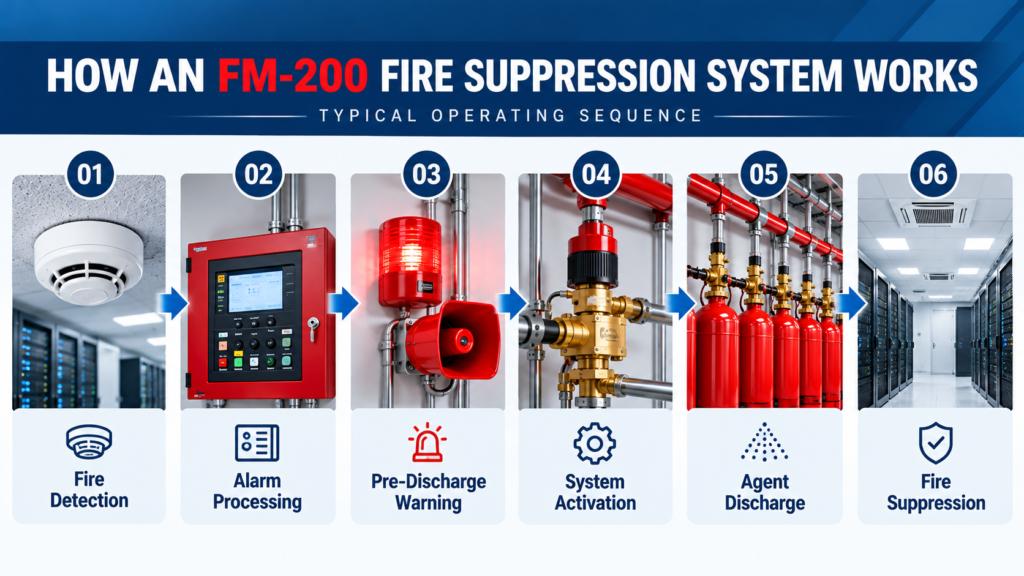
The sequence is managed through the interaction of detection devices, a releasing control panel, actuation equipment, and the extinguishing agent distribution system.
Additional functions, such as manual release, abort controls, ventilation shutdown, and discharge monitoring, may be incorporated according to the approved system design.
The specific operating logic must follow the applicable fire protection standards, equipment manufacturer’s instructions, and project requirements.
Step 1: Fire Detection and Initial Alarm
The operating sequence begins when a fire detection device identifies a potential fire condition within the protected area.
Smoke detectors are commonly used for early detection, while other detection technologies may be selected according to the fire hazards and environmental conditions.
When a detector operates, it sends a signal to the releasing control panel.
The panel processes this information according to the programmed detection and releasing logic.
Some FM-200 installations use cross-zoned detection, requiring signals from designated detection zones before the automatic release sequence begins. Other approved systems may use different detection arrangements.
Importantly, activation of a single smoke detector does not necessarily result in immediate FM-200 discharge.
The exact relationship between fire detection, alarm indication, and automatic release must be established during the system design process.
Step 2: Fire Alarm Processing and Releasing Control
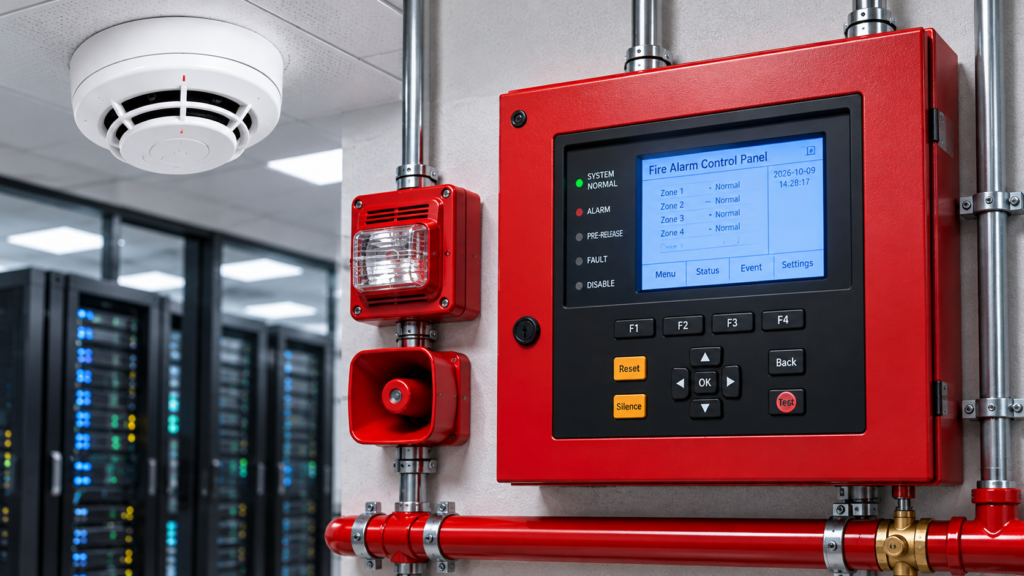
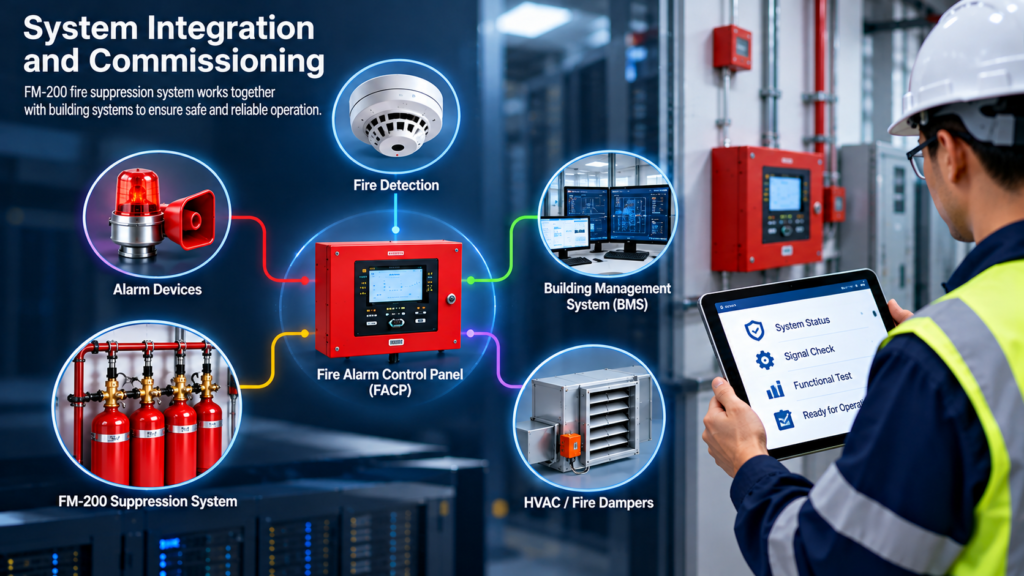
The releasing control panel serves as the central coordinating device for the FM-200 suppression system.
It receives detection signals and controls the relevant warning, actuation, and equipment interface functions.
Depending on the approved configuration, the control panel may:
- Identify and display the fire alarm condition.
- Activate audible and visual warning devices.
- Initiate the programmed automatic release sequence.
- Transmit signals to a building fire alarm system or monitoring equipment.
- Control designated ventilation and equipment shutdown interfaces.
- Activate the extinguishing system when the required release conditions are satisfied.
For larger facilities, the suppression system may also communicate with building management systems or other centralized monitoring equipment.
These interfaces must be clearly defined during engineering design.
A releasing control panel should not be treated simply as an accessory to the extinguishing cylinders. Its configuration is essential to the overall operating sequence and personnel safety arrangements.
Step 3: Pre-Discharge Warning and Safety Controls
Before automatic agent discharge, the system must provide the pre-discharge warnings and any evacuation delay required by the governing standard and approved system design.
Audible and visual warning devices alert personnel that an extinguishing agent release is being initiated or is imminent.
Depending on the project requirements, the control system may also perform coordinated actions such as:
- Shutting down designated ventilation equipment.
- Closing applicable ventilation dampers.
- Operating specified electrical or mechanical equipment interfaces.
- Activating warning indicators outside the protected enclosure.
These functions help prepare the protected area for agent discharge and support the required personnel safety measures.
Why Is a Pre-Discharge Delay Important?
Where an evacuation delay is required, it provides time for personnel to respond to the warning and leave the protected area before the extinguishing agent is released.
The delay should not be treated as a universal fixed setting.
Its requirement and duration depend on the applicable standards, occupancy conditions, equipment configuration, and approved fire protection design.
The releasing sequence must balance personnel safety with the need for effective fire suppression.
Step 4: Automatic and Manual System Activation
Once the required release conditions have been satisfied, the system initiates the extinguishing agent release sequence.
The activation method depends on the installed equipment and approved control configuration.
Automatic Activation
In an automatically actuated system, the releasing control panel generates a release signal when the programmed conditions are satisfied.
For an electrically actuated arrangement, this signal operates the appropriate actuator or releasing device, initiating the opening of the storage container valve or the relevant actuation mechanism.
Manual Activation
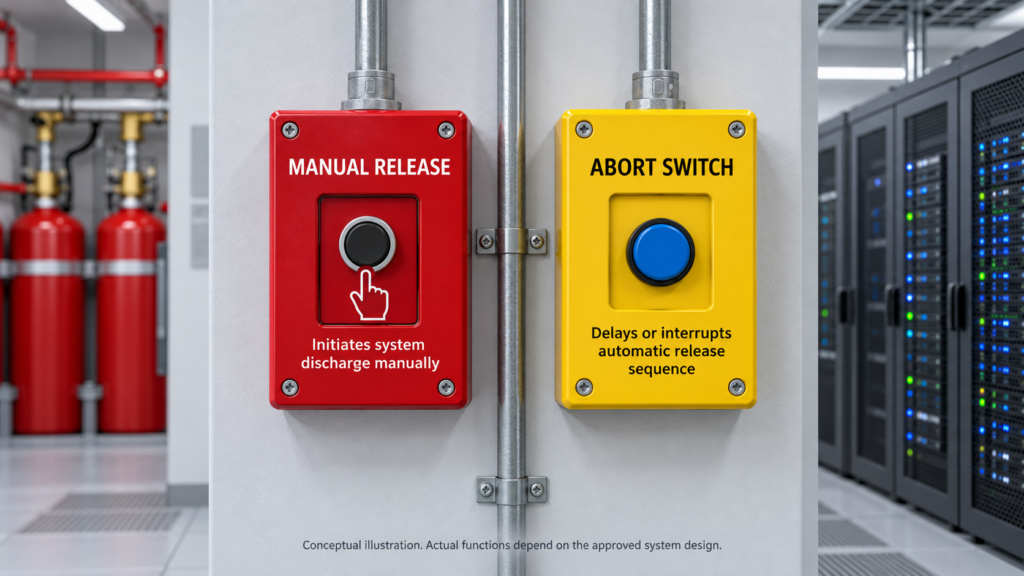
Many FM-200 systems incorporate designated manual release arrangements.
These allow authorized personnel to initiate the extinguishing sequence according to the approved operating procedures.
Depending on the system configuration, manual release may operate differently from automatic activation, including its interaction with programmed delays and abort functions.
What Does an Abort Switch Do?
Some releasing systems incorporate an abort switch that can delay or interrupt the automatic release sequence under defined conditions.
However, an abort switch must not be regarded as a universal emergency stop device.
Its operation depends on the specific releasing control equipment, applicable standard, and approved configuration.
Where NFPA 2001 governs the installation, manual release must take precedence over the abort function.
Once agent discharge has begun, the abort switch should not be assumed capable of stopping the flow of extinguishing agent.
All activation and abort functions must be documented and verified during commissioning.
Step 5: FM-200 Agent Discharge and Distribution
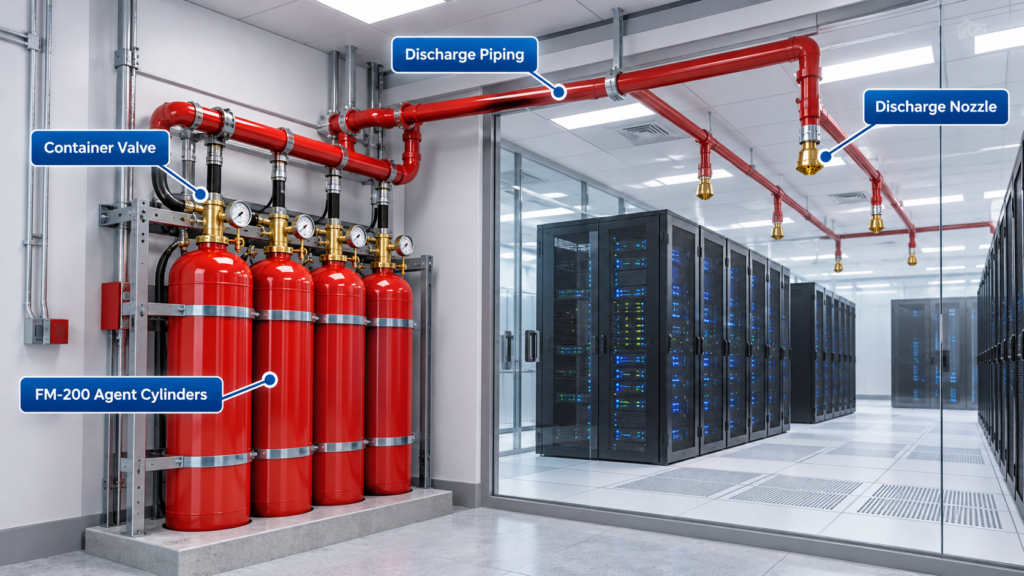
FM-200, chemically identified as HFC-227ea, is typically stored as a pressurized liquid in extinguishing agent containers.
When the system is activated, the agent is released through the appropriate discharge arrangement.
As the agent enters the protected space, it vaporizes and disperses to help establish the required extinguishing concentration.
Piped FM-200 Systems
In an engineered piped system, the agent travels from the storage containers through a distribution piping network and is discharged through appropriately selected nozzles.
The piping arrangement, nozzle locations, and agent flow characteristics must be determined through the relevant engineering design process.
Cabinet-Type FM-200 Systems
In a cabinet-type arrangement, the extinguishing agent container and discharge equipment are assembled within a cabinet unit.
The discharge configuration is determined by the particular cabinet system design and the protected area requirements.
ANKUNTAI also provides FM-200 Cabinet Fire Extinguishing Systems for project-specific fire suppression applications.
What Affects Agent Distribution?
Several factors influence the discharge arrangement:
- Protected enclosure dimensions and volume.
- Required extinguishing agent concentration.
- Agent storage capacity and arrangement.
- Distribution piping and hydraulic calculations.
- Nozzle selection, positioning, and discharge characteristics.
- Manufacturer’s design limitations and applicable standards.
Discharge performance must be evaluated for the specific system.
It should not be assumed that all FM-200 installations use the same discharge time, pressure arrangement, or nozzle configuration.
Step 6: How FM-200 Extinguishes Fire
FM-200 suppresses fire primarily by absorbing heat from the combustion process, with a secondary chemical effect that also contributes to flame extinguishment.
When the agent is discharged into a properly designed total flooding enclosure, the system is intended to establish the required extinguishing concentration throughout the protected space.
HFC-227ea is electrically non-conductive and does not leave solid extinguishing residue after discharge.
These characteristics make it suitable for consideration in certain facilities where water-related damage and equipment interruption are significant concerns.
However, the selection of FM-200 must still account for the specific fire hazards, occupancy conditions, agent safety limitations, and environmental requirements.
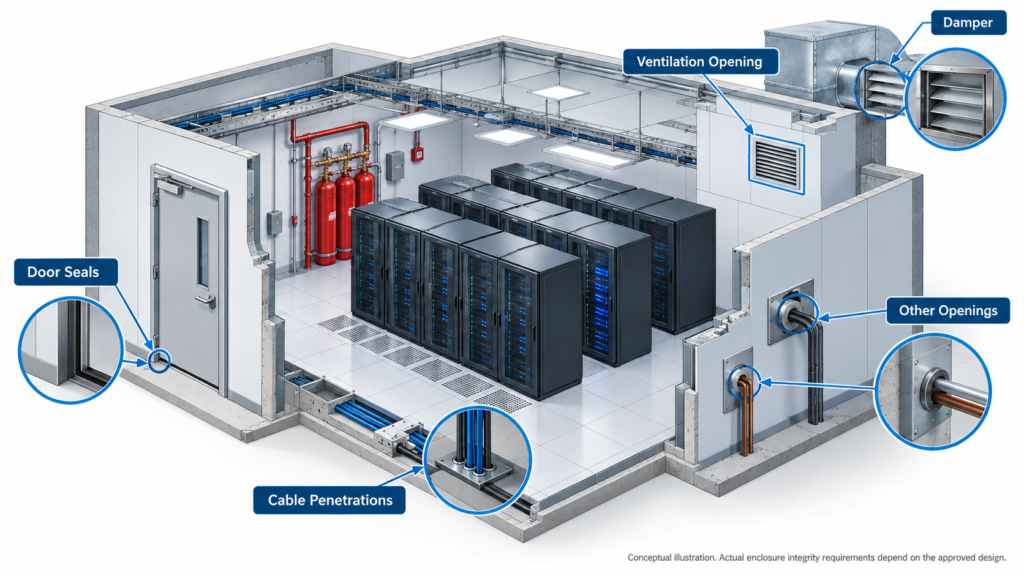
Why Is Enclosure Integrity Important?
Successful total flooding protection depends on the protected enclosure being capable of achieving and maintaining the necessary agent concentration.
Open doors, unsealed cable penetrations, ventilation openings, and other leakage paths can reduce agent retention.
For this reason, the design must consider:
- Room enclosure integrity.
- Door and opening conditions.
- Cable and pipe penetration sealing.
- Ventilation and damper arrangements.
- Required agent concentration retention.
- Applicable enclosure integrity testing requirements.
The extinguishing agent alone cannot compensate for inadequate enclosure protection.
Step 7: What Happens After FM-200 Discharge?
Agent discharge does not mean the protected area can immediately return to normal operation.
After a discharge event, the site must follow its established emergency response and safety procedures.
Personnel should not re-enter the protected enclosure simply because visible flames have disappeared.
The post-discharge assessment should consider potential fire re-ignition, hazardous thermal decomposition products, atmospheric conditions, ventilation requirements, and any remaining electrical or mechanical hazards.
Authorized personnel must determine when safe access can be permitted.
System Inspection and Restoration
After discharge, qualified personnel should inspect the system and complete the necessary restoration procedures.
These may include:
- Investigating the cause of the fire and system activation.
- Inspecting the extinguishing agent storage containers.
- Recharging or replacing discharged containers as required.
- Checking valves, actuators, and associated release components.
- Inspecting relevant piping and discharge equipment.
- Verifying fire detection, alarm, and releasing control functions.
- Completing the required functional tests before returning the system to service.
All restoration work should follow the applicable manufacturer’s instructions and project requirements.
Automatic Release vs. Manual Release vs. Abort: Key Differences
Understanding the different control functions helps project teams define the operating sequence and avoid confusion during commissioning.
| Function | Main purpose | Key consideration |
|---|---|---|
| Automatic Release | Initiates suppression when the programmed release conditions are satisfied | Depends on the approved detection and control logic |
| Manual Release | Allows authorized personnel to initiate the releasing sequence | May override automatic release delays or abort functions, depending on the governing requirements |
| Abort Function | Delays or interrupts the automatic release sequence where provided | Does not serve as a universal means of stopping discharge |
| Pre-Discharge Warning | Alerts personnel before agent discharge | Must meet applicable warning and evacuation requirements |
| Discharge Indication | Provides a signal associated with system discharge | Does not independently confirm that the fire has been extinguished |
The actual functions and their interactions must be confirmed for the selected releasing control equipment.
Why FM-200 System Integration Matters for EPC Projects
An FM-200 fire suppression installation often requires coordination between several contractors, equipment suppliers, and building service systems.
The extinguishing system may interface with fire alarm equipment, ventilation systems, electrical controls, building management systems, and monitoring equipment.
If the responsibilities for these interfaces are not clearly defined, problems may arise during installation, commissioning, or final project acceptance.
Eight Questions to Confirm Before Commissioning
- Which detection devices and signals initiate the automatic release sequence?
- What conditions must be satisfied before the extinguishing system activates?
- Which audible and visual alarms operate during each stage?
- What pre-discharge warning and evacuation delay requirements apply?
- Which ventilation or equipment control interfaces must operate?
- How do manual release and abort functions interact?
- How is agent discharge indicated and monitored?
- Which functional tests and acceptance procedures are required?
These requirements should be documented through the approved cause-and-effect matrix, system drawings, equipment documentation, and commissioning procedures.
For EPC and fire protection contractors, confirming these details early can help reduce coordination problems and clarify the scope of supply.
Frequently Asked Questions About FM-200 System Operation
Does FM-200 discharge immediately when smoke is detected?
Not necessarily. A detection signal may initially activate an alarm without immediately releasing the extinguishing agent. The actual releasing sequence depends on the approved detection logic, safety requirements, and control configuration.
Can an FM-200 system be activated manually?
Yes. FM-200 systems can incorporate manual release arrangements. Their operation and interaction with automatic controls depend on the approved system configuration.
Does an FM-200 system automatically shut down ventilation?
Ventilation shutdown and damper control may be integrated into the releasing sequence where required. The specific interfaces depend on the building conditions and approved fire protection design.
Can an abort switch stop FM-200 discharge?
An abort switch, where provided, affects the automatic releasing sequence under defined conditions. It should not be assumed capable of stopping agent discharge once release has begun.
Is FM-200 suitable for every type of fire?
No. FM-200 system suitability depends on the identified fire hazards, applicable standards, occupancy conditions, and extinguishing system design limitations. It should not be selected without evaluating the protected risk.
Does an FM-200 system need inspection after discharge?
Yes. Following a discharge event, the system requires appropriate inspection, restoration, and verification before being returned to service.
Conclusion
An FM-200 fire suppression system operates through a coordinated sequence of fire detection, alarm processing, pre-discharge warning, system activation, agent distribution, and fire suppression.
Effective operation depends on the proper integration of detection devices, releasing controls, extinguishing equipment, and building service interfaces.
For EPC contractors, fire protection engineers, and project buyers, understanding this operating sequence helps identify design requirements, define interface responsibilities, and prepare for installation and commissioning.
Planning an FM-200 Fire Suppression Project?
Guangzhou Ankuntai Fire Protection Technology Co., Ltd. supplies FM-200 fire suppression equipment and supports project-specific technical discussions.
If you are planning an FM-200 project, you can share the following information with our team:
- Protected area dimensions and estimated volume.
- Floor plans or relevant engineering drawings.
- Identified fire hazards and protected equipment.
- Project location and applicable standards.
- Relevant installation and control interface requirements.
Our team can review the available project information and discuss suitable equipment configurations and the next steps for technical evaluation.
Contact ANKUNTAI to discuss your FM-200 fire suppression project requirements.
Technical References
- ISO 14520-1:2023 — Gaseous Fire-Extinguishing Systems: General Requirements
- NFPA 2001 — Standard on Clean Agent Fire Extinguishing Systems (refer to the edition adopted for the project).
- Applicable FM-200 system manufacturer’s installation, operation, and maintenance documentation.
Technical note: The operating sequences and control functions described in this article are general engineering principles. Actual functions, timing, interfaces, and system performance depend on the selected equipment, approved design, applicable standards, and project requirements.