
For data centers, electrical rooms, control rooms, telecommunications facilities, and other critical spaces, fire protection is not only about extinguishing a fire. Where water or dry chemical residue is undesirable, an FM-200 fire suppression system using HFC-227ea can be considered as a clean agent fire protection solution.
This guide explains what an FM-200 fire suppression system is, how it works, its main components and configurations, common applications, key design considerations, and the standards typically referenced for HFC-227ea systems.
What Is FM-200 (HFC-227ea)?
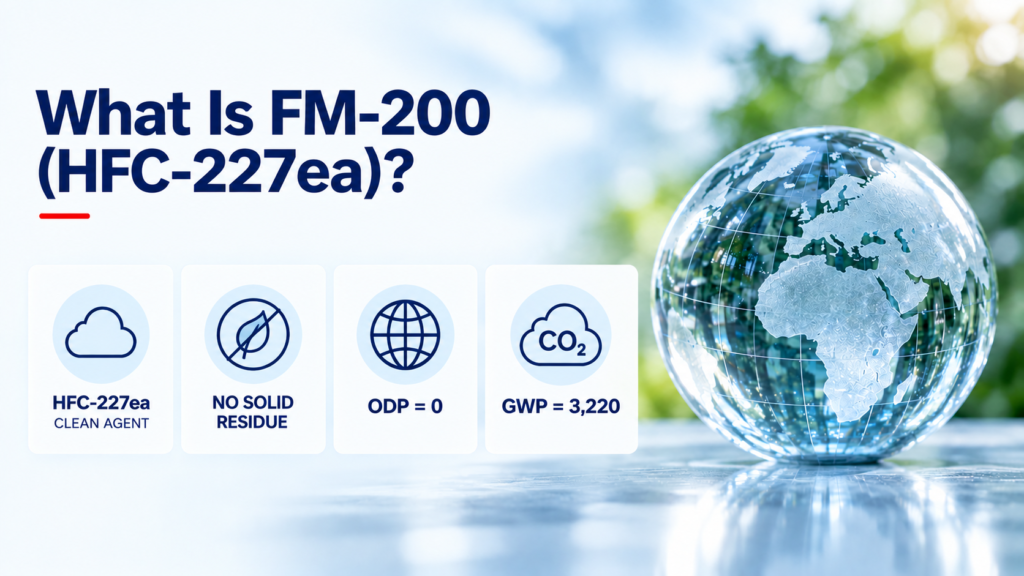
FM-200™ is a trade name associated with HFC-227ea (heptafluoropropane), a gaseous clean agent used in fire suppression systems. It is colorless, electrically non-conductive, and leaves no solid residue after discharge, making it suitable for applications where sensitive electrical or electronic equipment may be present.
HFC-227ea has an ozone depletion potential (ODP) of zero. However, this does not mean it has zero environmental impact. According to current U.S. EPA information, HFC-227ea has a 100-year global warming potential (GWP) of 3,220.
How Does an FM-200 Fire Suppression System Work?
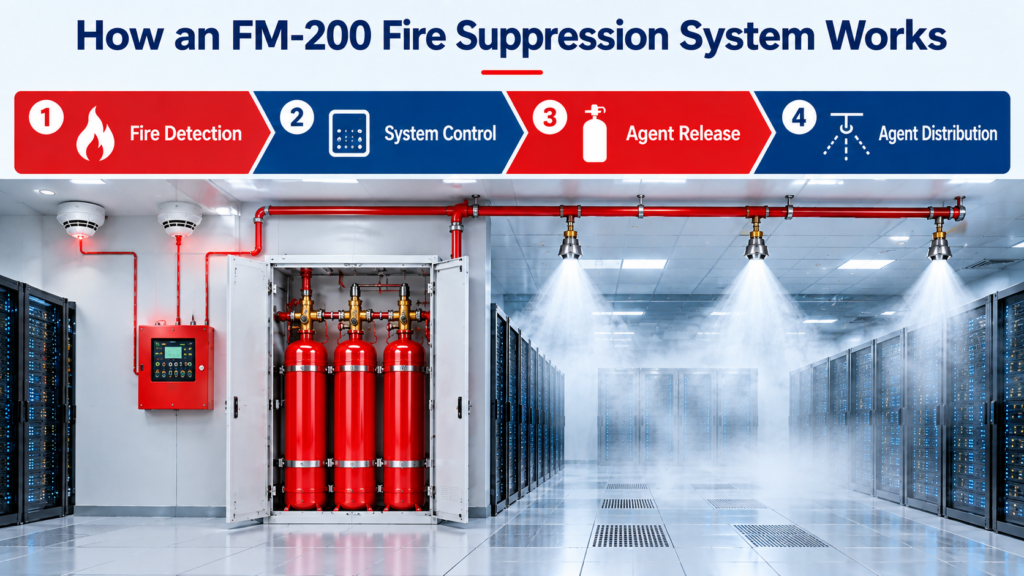
An FM-200 fire suppression system typically combines fire detection, system control, agent storage, and a distribution system. When a fire condition is detected and the required activation sequence is completed, the system releases HFC-227ea into the protected enclosure.
The basic operating sequence can be summarized in four steps:
1. Fire Detection — Smoke or heat detectors identify a fire condition and send a signal to the control system.
2. System Control — The fire suppression control panel processes the detection signals and initiates the programmed alarm and release sequence.
3. Agent Release — HFC-227ea is released from the agent cylinder or cylinder bank through the system valves and piping.
4. Agent Distribution — The agent is discharged through strategically positioned nozzles into the protected enclosure.
What Are the Main Components of an FM-200 Fire Suppression System?
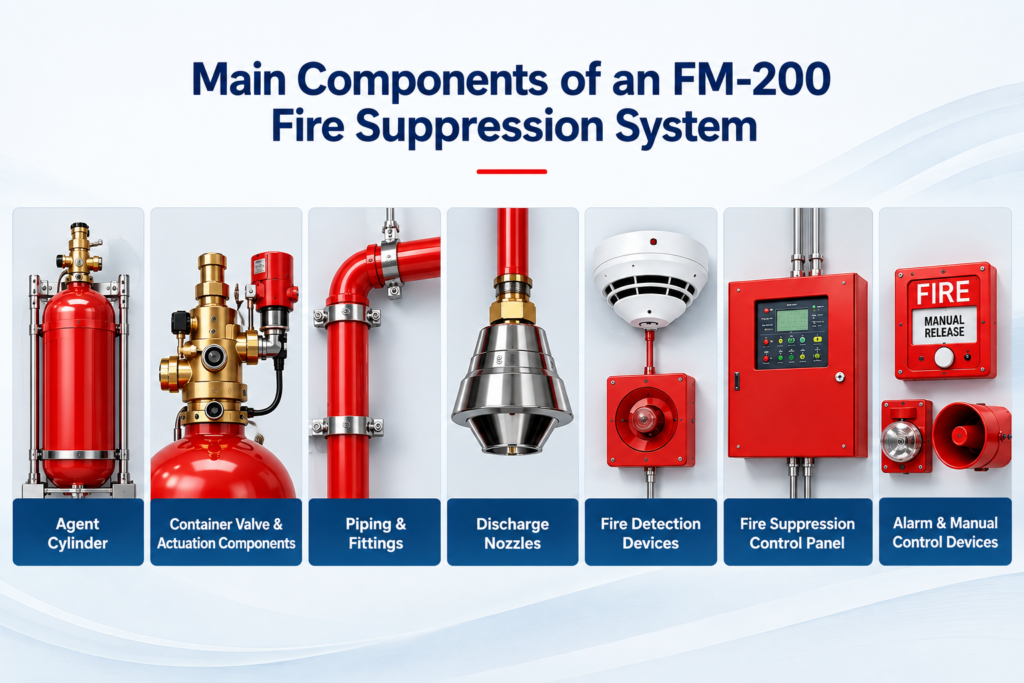
A complete FM-200 fire suppression system consists of several components that work together for fire detection, system activation, agent storage, and agent distribution. The exact configuration depends on the protected space and project design requirements.
1. Agent Cylinder — Stores the HFC-227ea extinguishing agent required for the protected enclosure.
2. Container Valve and Actuation Components — Control the release of the extinguishing agent when the system is activated.
3. Piping and Fittings — Carry the agent from the cylinder or cylinder bank to the discharge points in a pipe-network system.
4. Discharge Nozzles — Distribute HFC-227ea into the protected enclosure according to the system design.
5. Fire Detection Devices — Detect fire conditions and send signals to the fire suppression control system.
6. Fire Suppression Control Panel — Processes system signals and manages the programmed alarm and release sequence.
7. Alarm and Manual Control Devices — Provide system notification and manual control functions as required by the project design.
What Types of FM-200 Fire Suppression Systems Are Available?
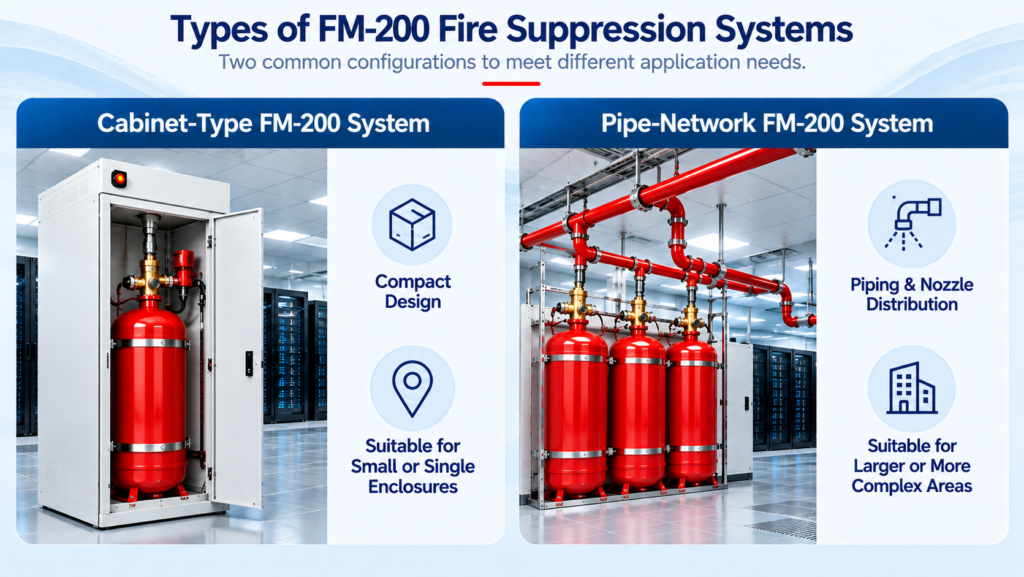
FM-200 fire suppression systems can be configured in different ways depending on the protected space, system layout, and project requirements. Two common configurations are cabinet-type systems and pipe-network systems.
Cabinet-Type FM-200 System
A cabinet-type FM-200 system integrates the agent cylinder and related components into a compact cabinet. It is typically installed close to or within the protected area and can be suitable for single rooms or relatively small enclosures where extensive distribution piping is not required.
Pipe-Network FM-200 System
A pipe-network FM-200 system uses distribution piping and discharge nozzles to deliver HFC-227ea from the agent cylinder or cylinder bank to the protected enclosure. The system configuration is engineered according to the project requirements and can be used for larger or more complex protection arrangements.
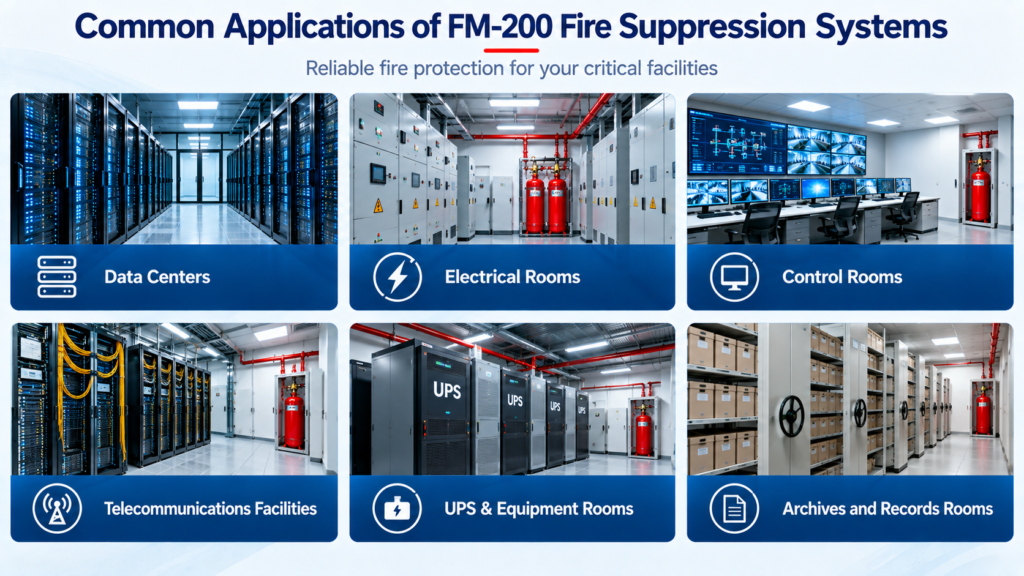
Where Are FM-200 Fire Suppression Systems Commonly Used?
FM-200 fire suppression systems are commonly used in enclosed spaces where rapid fire suppression and protection of sensitive or high-value equipment are important. Because HFC-227ea is a gaseous clean agent that leaves no solid residue after discharge, it is often considered for facilities containing electrical, electronic, communication, or other critical equipment.
Data Centers and Server Rooms — Protection for servers, network equipment, and other IT infrastructure.
Electrical Rooms — Protection for switchgear, electrical panels, and other electrical equipment.
Control Rooms — Protection for monitoring, automation, and control equipment.
Telecommunications Facilities — Protection for communication and network infrastructure.
UPS and Equipment Rooms — Protection for UPS systems and other critical equipment.
Archives and Records Rooms — Protection for documents, records, and other valuable stored materials.
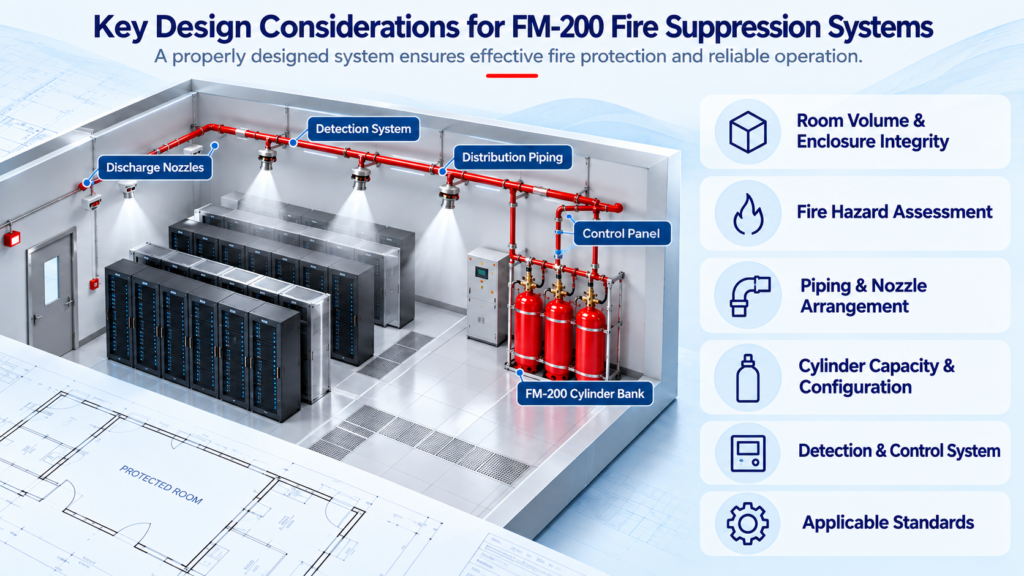
Key Design Considerations for an FM-200 Fire Suppression System
An FM-200 system should be designed according to the specific protected space, fire hazard, enclosure conditions, and applicable project requirements. The required agent quantity and system configuration should therefore be determined on a project-by-project basis.
Room Volume and Enclosure Integrity — Room dimensions, net protected volume, openings, and enclosure conditions should be considered when determining the system design.
Fire Hazard Assessment — The equipment and potential fire hazards within the protected space should be identified as part of the design process.
Piping Layout and Nozzle Arrangement — For pipe-network systems, piping and nozzle locations should be engineered to achieve the required agent distribution.
Cylinder Capacity and Configuration — The number and size of cylinders depend on the calculated agent quantity and selected system configuration.
Detection and Control System — Detection methods, alarms, release logic, and manual controls should be selected according to the project requirements.
Applicable Standards — System design and installation should follow the applicable standards, local regulations, AHJ requirements, and project specifications.
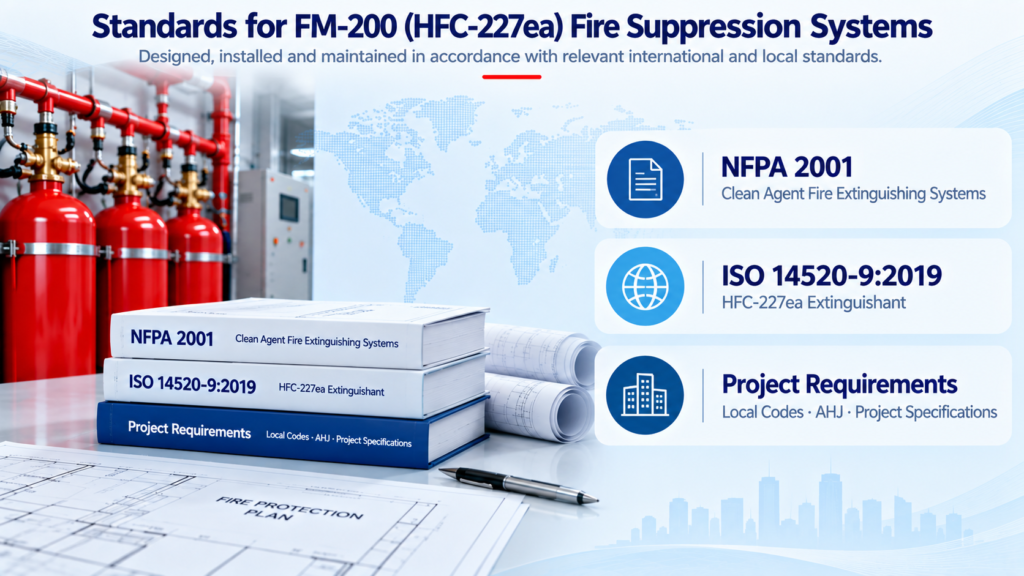
Standards Commonly Referenced for FM-200 Fire Suppression Systems
FM-200 (HFC-227ea) fire suppression systems should be designed, installed, tested, and maintained in accordance with the applicable codes, standards, local regulations, and project specifications. Two commonly referenced international standards for clean agent fire suppression systems are NFPA 2001 and the ISO 14520 series.
NFPA 2001 — Standard on Clean Agent Fire Extinguishing Systems
Provides requirements for the design, installation, testing, maintenance, and use of clean agent fire extinguishing systems.
ISO 14520-9:2019 — Gaseous Fire-Extinguishing Systems: HFC 227ea Extinguishant
Specifies requirements specifically related to HFC-227ea extinguishing systems and should be used together with the general requirements of the ISO 14520 series.
What Information Is Needed Before Designing or Quoting an FM-200 System?
To prepare an appropriate FM-200 system proposal, the system supplier or designer needs sufficient project information to determine the required configuration. Providing complete information at the beginning can also make technical evaluation and quotation more efficient.
Project Location — Country and project location, which may affect applicable codes and project requirements.
Room Dimensions or Drawings — Length, width, height, protected volume, room layout, and relevant openings where available.
Protected Equipment and Application — For example, data center, electrical room, control room, telecommunications room, or other protected space.
Required Standard or Project Specification — Applicable standards, consultant specifications, tender documents, or other project requirements.
Cylinder Installation Conditions — Available installation location and space for the agent cylinder or cylinder bank.
Piping and System Configuration — Information needed to evaluate cabinet-type or pipe-network arrangements.
Detection and Control Requirements — Required detection, alarm, release, and control functions.
BOQ or Technical Specification — If available, provide the project BOQ, drawings, or technical specifications for review.
Frequently Asked Questions About FM-200 Fire Suppression Systems
Is FM-200 the Same as HFC-227ea?
FM-200™ is a trade name associated with HFC-227ea, while HFC-227ea is the generic designation for the extinguishing agent. In fire suppression projects, the terms are often used together when referring to systems using HFC-227ea.
Does FM-200 Leave Residue After Discharge?
HFC-227ea is a gaseous clean agent and does not leave solid residue after discharge. This is one reason it is commonly considered for spaces containing sensitive electrical and electronic equipment.
Is FM-200 Suitable for Electrical and Electronic Equipment?
FM-200 systems are commonly used in spaces containing electrical and electronic equipment because HFC-227ea is electrically non-conductive and leaves no solid residue after discharge. Typical applications include data centers, electrical rooms, control rooms, telecommunications facilities, and UPS rooms.
Is FM-200 Environmentally Friendly?
HFC-227ea has an ozone depletion potential (ODP) of zero. However, it still has a global warming impact, so it should not be described as having zero environmental impact. According to current U.S. EPA information, HFC-227ea has a 100-year global warming potential (GWP) of 3,220.
How Much FM-200 Agent Is Required for a Fire Suppression System?
The required amount of HFC-227ea must be determined for each project based on factors such as the protected volume, design concentration, minimum design temperature, fire hazard, enclosure conditions, and applicable standards. The agent quantity should be calculated as part of the system design rather than selected using a fixed amount.
What Information Is Needed to Get an FM-200 System Quotation?
To prepare an FM-200 system quotation, please provide the room dimensions or drawings, protected application, project location, required standards or specifications, available cylinder installation space, and any BOQ or technical documents. This information helps determine the appropriate system configuration and agent quantity.
Planning an HFC-227ea Fire Suppression Project?
ANKUNTAI supports HFC-227ea fire suppression projects for data centers, electrical rooms, control rooms, telecommunications facilities, and other critical applications.
To discuss your project, please send us your application, room dimensions or drawings, project location, required standard or technical specification, and project schedule. Our team can review the information and support you with system configuration and quotation.
Contact ANKUNTAI to discuss your FM-200 / HFC-227ea fire suppression project.