
Substation is the core hub of the power system, which gathers a large number of expensive and highly safety demanding electrical equipment such as transformers, circuit breakers, and control cabinets. Once a fire occurs, it will not only cause huge direct economic losses, but may also trigger large-scale power outages, affecting the normal operation of society. Water, foam and other traditional fire extinguishing media cannot be safely used for electrical equipment fire fighting due to their conductivity and residue problems. In this context, the pipeline FM-200 (heptafluoropropane) gas fire extinguishing system has become an ideal choice for protecting critical infrastructure such as substations due to its high efficiency, cleanliness, and non-conductive properties.
1、 What is FM-200 fire extinguishing agent?
FM-200 is the generic trade name for heptafluoropropane (HFC-227ea) in the international firefighting industry, with the molecular formula CF ∝ CHFCF ∝. At room temperature and pressure, it is a colorless, odorless, non-conductive gas fire extinguishing agent that can be stored in low-pressure liquefaction. Its density is about 6 times that of air.
The core advantages of FM-200 are reflected in the following aspects:
Efficient fire extinguishing: With high fire extinguishing efficiency, it can extinguish general flammable liquid or electrical fires within 10 seconds or even shorter after spraying.
Clean and residue free: After extinguishing the fire, no residue is left, and there is no secondary damage to precision electronic equipment. It can be directly discharged through the ventilation system.
Non conductive: Suitable for extinguishing fires in live equipment without causing short circuits or equipment damage.
Environmentally friendly: It has no destructive effect on the atmospheric ozone layer (with an ODP value of zero) and has a relatively short residual time in the atmosphere.
Low toxicity safety: relatively safe for human body at the designed concentration for fire extinguishing, suitable for places with frequent human activities.
2、 Working principle of pipeline system
The pipe network FM-200 fire extinguishing system belongs to the fully submerged fire extinguishing system, which means that the fire extinguishing agent is evenly sprayed onto the entire protective area through a fixed pipe network and nozzle to achieve the fire extinguishing concentration.
The fire extinguishing mechanism is a combination of physical cooling and chemical inhibition:
Physical cooling: FM-200 rapidly vaporizes after spraying, absorbing a large amount of heat and reducing the flame temperature.
Chemical inhibition: The fire extinguishing agent decomposes under the high temperature of the flame to produce active free radicals, which seize the active substances in the combustion chain reaction, disrupt the chain transmission of the combustion process, and ultimately achieve the purpose of fire extinguishing.
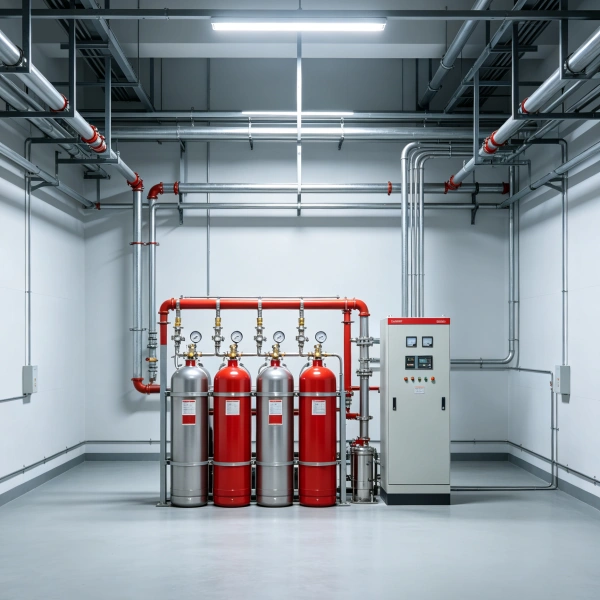
The core difference between a pipeline system and a cabinet or non pipeline system is that the fire extinguishing agent storage bottles are centrally placed in dedicated gas cylinder rooms, and the fire extinguishing agent is transported to various protective areas through the laid pipeline network. This design is particularly suitable for scenarios such as substations where protective zones are scattered and spatial layouts are complex.
3、 The core components of the system
A complete pipeline FM-200 fire extinguishing system mainly consists of the following three parts:
- Pipeline network section
Selection valve: used in combination distribution systems to guide fire extinguishing agents to specific protective areas where fires occur.
One way valve: prevents the backflow of fire extinguishing agent.
Collecting pipe: Collecting the fire extinguishing agent released from each storage bottle.
Transport pipeline: Transport the fire extinguishing agent from the gas cylinder room to the protective area. In substation engineering, it is usually required to use hot-dip galvanized seamless steel pipes inside and outside to meet the requirements of the maximum design working pressure.
Nozzle: Installed in the protective zone, responsible for evenly spraying the fire extinguishing agent. - Fire extinguishing equipment section
Fire extinguishing agent storage bottle: high-pressure steel cylinder for storing liquid FM-200.
Container valve: installed on the storage bottle to control the release of fire extinguishing agent.
Nitrogen driven cylinder group: used to provide a starting gas source.
Electromagnetic starter: Receive fire alarm signals and automatically start the system. - Electrical control part
Fire detector: smoke and temperature detectors, real-time monitoring of fire situations in protected areas.
Fire alarm controller: Receive detector signals, issue alarms, and activate the fire extinguishing system in conjunction.
Emergency start stop button: for duty personnel to manually start or stop the fire extinguishing procedure in emergency situations.
Summary
The substation pipeline FM-200 fire extinguishing system is an efficient, clean, and safe fire protection solution designed specifically to protect high-value electrical equipment. It can deliver fire extinguishing agents to various protective areas in a very short time after a fire occurs through centrally arranged storage bottles and carefully designed pipe networks, quickly extinguishing the fire without causing any secondary damage to the equipment. For modern substations that pursue high reliability and safety, this is an indispensable safety line of defense.